Under the Microscope: NASA-Made Material for Moon Manufacturing
Story summary
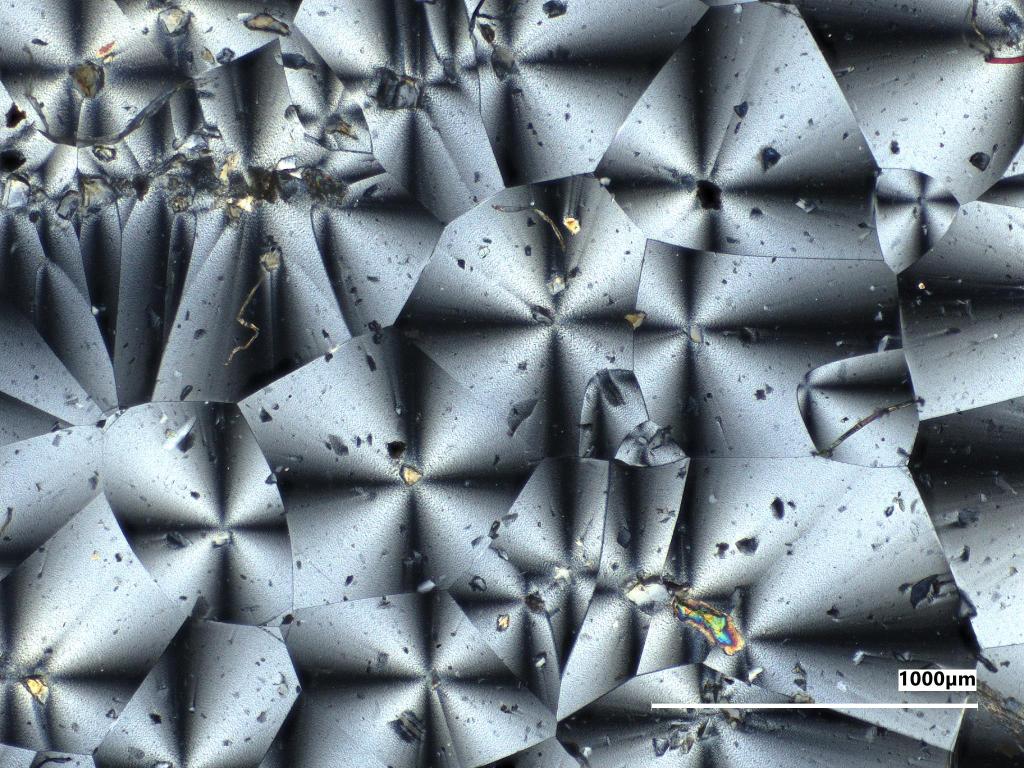
Photos taken using a microscope reveal the colorful, kaleidoscope-like crystal structure of a new NASA-made material that could be used for manufacturing during future space missions. Developed at NASA’s Glenn Research Center in Cleveland, the material could be created directly on the Moon or Mars,
📌 Key Highlights & Takeaways
- Photos taken using a microscope reveal the colorful, kaleidoscope-like crystal structure of a new NASA-made material that could be used for manufacturing during future space missions.
- Developed at NASA’s Glenn Research Center in Cleveland, the material could be created directly on the Moon or Mars,
Photos taken using a microscope reveal the colorful, kaleidoscope-like crystal structure of a new NASA-made material that could be used for manufacturing during future space missions. Developed at NASA’s Glenn Research Center in Cleveland, the material could be created directly on the Moon or Mars, allowing NASA to pack fewer supplies — saving weight and reducing launch costs.
To make the material, research chemical engineer Allison Christy and her team of summer interns at NASA Glenn — Tyler Klinchuch, Ethan Bilodeau, and Emma Levenson — mixed a special plastic with simulated Moon and Mars dust. This plastic is biodegradable and could be produced by bacteria fed with crew waste or carbon dioxide.
“The plastic literally grows within the bacteria’s little bodies,” Christy said. “It’s really cool.”
The team found that incorporating simulated lunar and Martian dust particles into this plastic made it stronger and easier to process. Adding different types and amounts of dust allowed them to adjust the material’s properties. The gray image shows sample material manufactured using mock Moon dust, while the reddish image shows material made with mock Mars dust.
The material could be used to manufacture equipment used inside future Moon or Mars habitats, like structural brackets, wrenches, or chairs. By potentially enabling on‑demand, fully recyclable fabrication with lunar surface material, this could help advance NASA’s objective of a permanent Moon Base by reducing resupply needs and empowering crews to build and repair essential equipment on-site.
“You can’t just bring everything with you to the Moon or Mars,” Christy said. “If something breaks, you have to find a way to fix it with what you have. This is a very versatile material, which is a huge benefit.”
Going forward, the team hopes to analyze whether this material could also be used outside in the harsh environments of the lunar or Martian surfaces.
The material is now undergoing testing in Glenn’s Lunar Environment Structural Test Rig to see how it holds up in extreme temperatures. Several samples are also slated to launch aboard the upcoming Materials International Space Station Experiment 23 (MISSE-23) mission and will be exposed to intense conditions outside the station.
Editorial Text & Content Analyzer
Analyze real-time word count, reading speed, and text density metrics on the fly.
Source: NASA.
Read the full story at the original source ↗
For questions: mrsmithcons@gmail.com.
🔭 Full 4K Astrophotography Dossier & Scientific Analysis
Raw multi-band infrared composite data, spectral graphs, and mission notes.
⚡ Access Cosmic Dossier ➔More from FreeSky Cosmos
 ⚡ CyberTech 568
Instinct founder said more than 50% of transactions on the platform are travel-related
Instinct founder said that the platform is growing 10% day-by-day...
NASA Armstrong Celebrates 80 Years of Flight Innovation
On Sept. 30, 1946, five National Advisory Committee of Aeronautics (NACA) engineers arrived at Muroc Army Airf...
 🤖 WinBar AI
OddsTrader Review 2026: Free Odds Comparison and AI Picks — Is It Worth Using?
Breaking coverage reported by Picks and Parlays: OddsTrader Review 2026: Free Odds Comparison and AI Picks — I...
 ☁️ FreeSky Cloud
AWS Weekly Roundup: GPT-6 Sol and Luna, Claude Opus 5.5 on Amazon Bedrock, Strands harness, and more (September 28, 2026)
If there’s one theme that defined last week, it’s choice. The frontier models keep arriving, and the interesti...