NASA’s Webb Captures Commotion From Nebula’s Stellar Jets
Story summary
A cauldron of cosmic creation is being revealed in a new image from NASA’s James Webb Space Telescope. Webb has unveiled numerous stars formerly hidden by clouds of dust in a stellar nursery known as NGC 7129, which resides about 3,300 light-years from Earth. Stars, the engines of elemental creation
📌 Key Highlights & Takeaways
- A cauldron of cosmic creation is being revealed in a new image from NASA’s James Webb Space Telescope.
- Webb has unveiled numerous stars formerly hidden by clouds of dust in a stellar nursery known as NGC 7129, which resides about 3,300 light-years from Earth.
- Stars, the engines of elemental creation
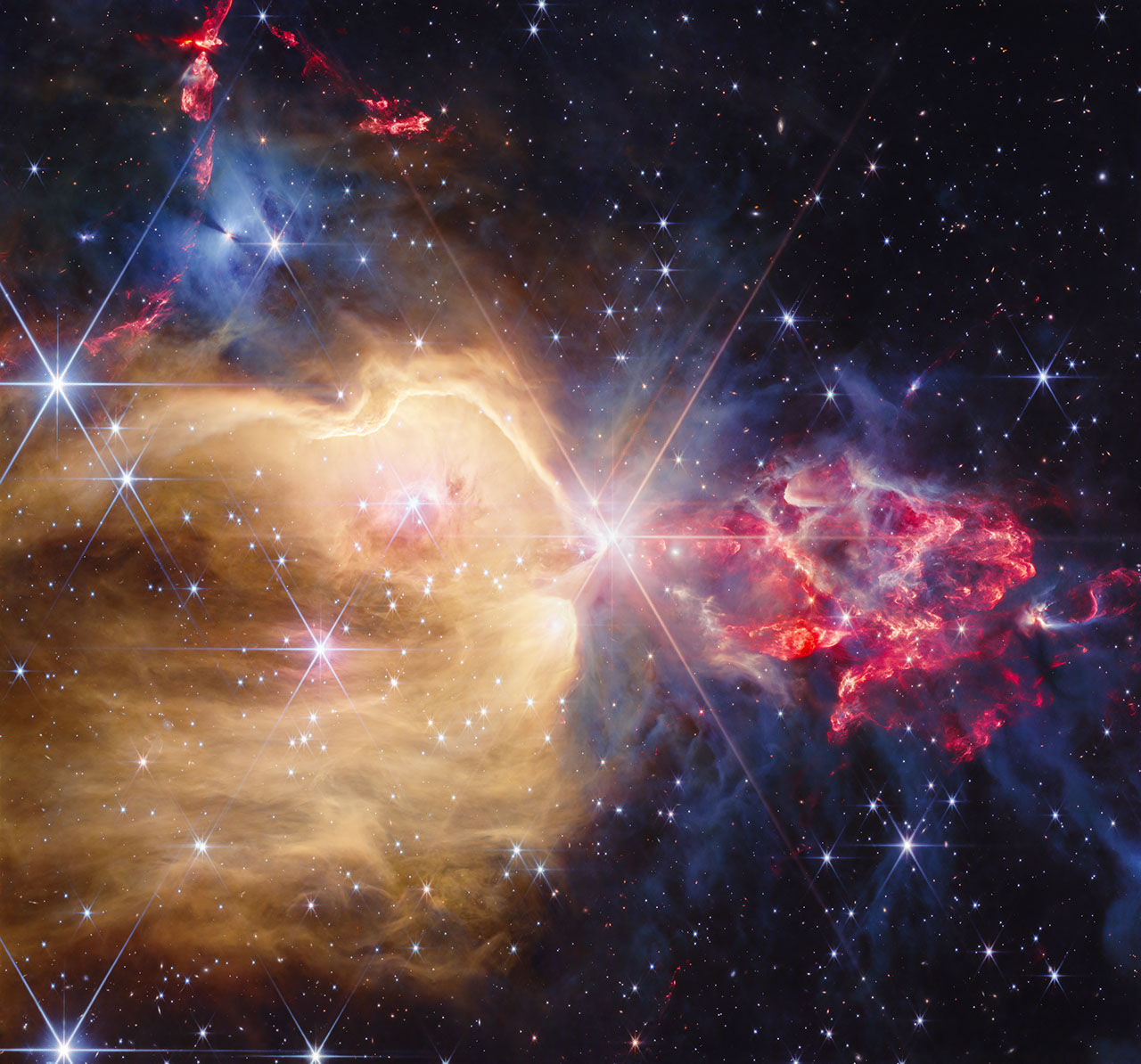
Science James Webb Space Telescope (JWST) NASA’s Webb Captures… Webb News Latest News Latest Images Webb’s Blog Awards X (offsite – login reqd) Instagram (offsite – login reqd) Facebook (offsite- login reqd) Youtube (offsite) Overview About Who is James Webb? Fact Sheet Impacts+Benefits FAQ Webb Timeline Science Overview and Goals Early Universe Galaxies Over Time Star Lifecycle Other Worlds Science/Engineering Explainers Observatory Overview Launch Deployment Orbit Mirrors Sunshield Instruments & ISIM Module Instrument: NIRCam Instrument: MIRI Instrument: NIRSpec Instrument: FGS/NIRISS Optical Telescope Element Backplane Spacecraft Bus Webb vs Hubble -> Multimedia About Webb Images Images Videos Products & Activities Podcasts Webb Image Sonifications What is Webb Observing? 3d Webb in 3d Solar System Webb’s First Images Team International Team People Of Webb More For the Media For Scientists For Educators For Fun/Learning 5 Min Read NASA’s Webb Captures Commotion From Nebula’s Stellar Jets NASA’s James Webb Space Telescope has revealed many protostars and stars within the glowing gases of NGC 7129. Hot, atomic hydrogen gas is shown here in the golden region, while cooler, molecular hydrogen gas, shocked by embedded protostars, is represented in red. Credits: Image: NASA, ESA, CSA, STScI; Image Processing: Alyssa Pagan (STScI) A cauldron of cosmic creation is being revealed in a new image from NASA’s James Webb Space Telescope. Webb has unveiled numerous stars formerly hidden by clouds of dust in a stellar nursery known as NGC 7129, which resides about 3,300 light-years from Earth.
Stars, the engines of elemental creation, have life cycles that begin with their birth in molecular clouds – cold, dense regions of dust and gas. Because of these dusty cocoons, young stars are often impossible to view by many telescopes, particularly those incapable of capturing infrared light. Webb, however, has a high degree of infrared sensitivity, allowing astronomers to peer through that dust and study the beginning of the star life cycle.
The stars from this cluster are in different stages of their development, as the more massive stars form and evolve the fastest. The most massive (and the most mature) is the region’s luminous central star, LkH(alpha) 234 (pronounced Lick-H-alpha). This star, which sports the image’s most prominent diffraction pattern , is a pre-main-sequence star weighing around 5 to 8 times the mass of our Sun. Pre-main-sequence stars like these have mostly finished gathering mass and are contracting under the force of gravity, causing their temperatures to rise. In time, this star will fuse its own hydrogen like our Sun.
The cavity to its left, which appears in gold and spans about 3.5 light-years, is the largest demonstration of the central star’s impact. Outflows from an earlier stage of the star’s life cycle carve into the dense molecular cloud of hydrogen. Both the outflows and the star’s light energize the gas, causing it to glow. While much of this hydrogen gas is blown away, a large amount is also compressed, creating the conditions for even more stars to form.
A few of these stars are visible within the cavity. Several of them are also pre-main-sequence and emit stellar winds . The nearby bow shocks , the curved compressed gas that appears near the stars, are created as those winds push into the energetic gas and create their own, smaller cavities.
Together, the central and embedded stars also create the sharp ridge seen at the top of the golden cavity. Their light generates a hot environment that pushes against the colder and denser molecular gas outside the cavity, and creates a boundary known as a photodissociation region . In this region, the molecules of hydrogen break down into atoms. By influencing the temperature and chemistry of the region, this collection of stars offers insight into how these molecular clouds will gradually erode over millions of years.
The region to the right of the central star narrates a different, but equally chaotic tale. This clumpy matter represented in red hides much younger objects than those on the left: protostars. The protostar stage is earlier than the pre-main-sequence stage and occurs after molecular clouds of gas and dust initially compress and fragment.
As the protostars accumulate matter and increase their mass, they eject outflows of superheated material. These outflows interact with the dense, gray, translucent matter the protostars are wrapped within, creating shocks that cause a textured appearance. The red glow is also the result of the interaction. Multiple outflows from multiple stars overlap from our point of view, leading to the scene’s chaotic look.
Editorial Text & Content Analyzer
Analyze real-time word count, reading speed, and text density metrics on the fly.
Source: NASA.
Read the full story at the original source ↗
For questions: mrsmithcons@gmail.com.
❓ Frequently Asked Questions (James Webb Intel Briefing)
What orbital telemetry or sensor data corroborates this James Webb Intel discovery?
Multi-spectral satellite imagery, radar altimetry, and space agency observational feeds provide calibrated observational data confirming the parameters of this event.
How does this observation impact current aerospace and geospatial modeling?
The recorded metrics refine atmospheric correction algorithms and orbital ephemeris models, enabling higher resolution tracking and trajectory accuracy.
When is the next telemetry downlink or public briefing scheduled?
Real-time space agency mission updates and satellite overpass data are ingested continuously through FreeSky Cosmos tracking desks.
🔭 Full 4K Astrophotography Dossier & Scientific Analysis
Raw multi-band infrared composite data, spectral graphs, and mission notes.
⚡ Access Cosmic Dossier ➔More from FreeSky Cosmos

 🤖 WinBar AI
Sports Betting AI Agent: How Conversational Intelligence Is Reshaping the Bettor Experience in 2026
Breaking coverage reported by DailyGame: Sports Betting AI Agent: How Conversational Intelligence Is Reshaping...
‘Bent Left’ returns: Drone footage captures orca off the South Coast
‘Bent Left’ returns: Drone footage captures orca off the South Coast of NSW....
AI Trade Drives Wall Street
AI-linked technology stocks are lifting major indexes to records while much of the broader market weakens. Ana...
 ☁️ FreeSky Cloud
Essential Blueprint: How Leaders Are Navigating Free SaaS Tiers for High-Yield Performance in 2026
Comprehensive 2026 editorial analysis exploring Free SaaS Tiers on FreeSky Cloud. Discover key strategic frame...