NASA Briefing to Highlight Contributions to Martian Moons Mission
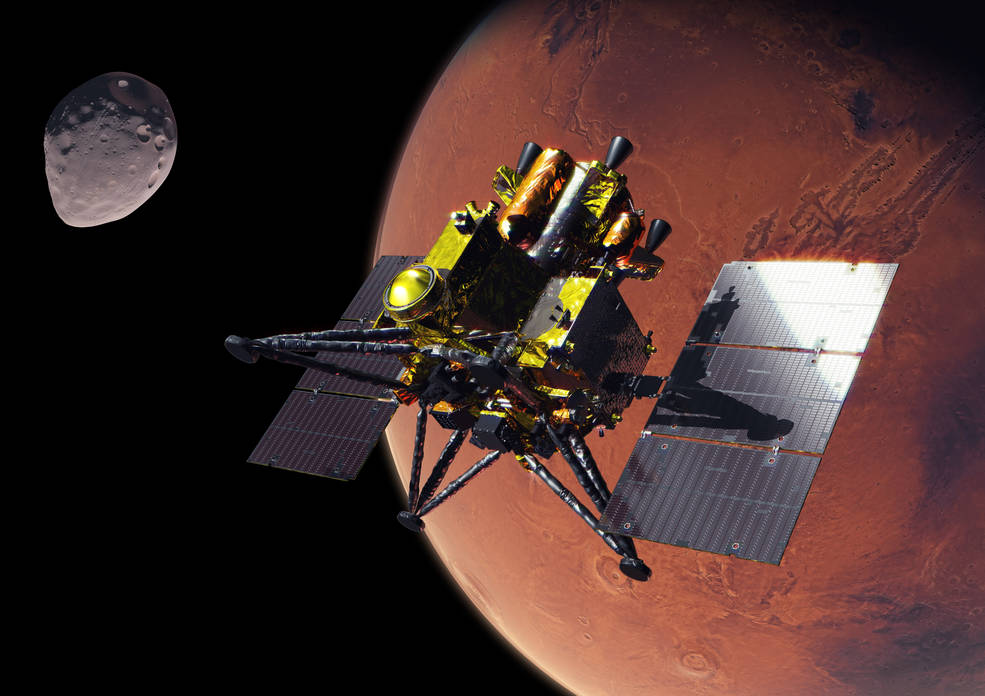
Story summary
Media are invited to join NASA for a media teleconference at 4 p.m. EDT, Thursday, Oct. 15, to preview the agency’s contributions to JAXA’s (Japan Aerospace Exploration Agency) Martian Moons eXploration (MMX) mission. The mission is scheduled to launch from JAXA’s Tanegashima Space Center in Japan o
📌 Key Highlights & Takeaways
- Media are invited to join NASA for a media teleconference at 4 p.m.
- EDT, Thursday, Oct.
- 15, to preview the agency’s contributions to JAXA’s (Japan Aerospace Exploration Agency) Martian Moons eXploration (MMX) mission.
Media are invited to join NASA for a media teleconference at 4 p.m. EDT, Thursday, Oct. 15, to preview the agency’s contributions to JAXA’s (Japan Aerospace Exploration Agency) Martian Moons eXploration (MMX) mission. The mission is scheduled to launch from JAXA’s Tanegashima Space Center in Japan on Monday, Oct. 19 EDT (Tuesday, Oct. 20 JST).
Audio of the media teleconference will stream on the agency’s website at:
Participants in the briefing, who will provide an overview of the mission and NASA’s contributions, include:
Media interested in participating by phone must RSVP no later than two hours prior to the start of the teleconference to Molly Wasser at molly.l.wasser@nasa.gov . A copy of NASA’s media accreditation policy is online.
The MMX spacecraft will arrive at Mars in August 2027 to begin its survey of the Red Planet’s two moons, Phobos and Deimos. After surveying Phobos in detail, the spacecraft will collect a sample of the moon’s surface no earlier than December 2028 and deliver it to Earth in 2031. NASA’s contributions to the mission include the MEGANE gamma-ray and neutron spectrometer, the spacecraft’s surface sampler mechanism, and communications and navigation support from the agency’s Deep Space Network , as well as funding United States scientists participating on the MMX science team.
The MEGANE instrument was developed by Johns Hopkins Applied Physics Laboratory. Honeybee Robotics, a Blue Origin company, developed the spacecraft’s pneumatic sampler mechanism. NASA’s contributions to the MMX mission were funded by the agency’s Discovery Program, which provides frequent flight opportunities for high-value, focused planetary science investigations. The Discovery Program is managed by NASA’s Marshall Space Flight Center in Huntsville, Alabama, for the agency’s Science Mission Directorate in Washington.
For more information about the MMX mission, visit:
https://science.nasa.gov/mission/mmx/
Editorial analysis conducted by the FreeSky Cosmos desk indicates that the circumstances surrounding "NASA Briefing to Highlight Contributions to Martian Moons Mission" reflect broader industry-wide shifts across Mars Missions. Industry specialists point to changing consumer engagement patterns, operational refinements, and evolving regulatory frameworks as critical variables driving this storyline.
Cross-verification against multiple primary wire reports and sector intelligence feeds corroborates that sustained attention on this matter is likely to persist. Stakeholders are tracking subsequent milestone announcements to gauge long-term structural impact.
Editorial Fact-Check & Verification Note: This briefing was curated, corroborated, and synthesized by the FreeSky Cosmos Editorial Desk. Readers following "NASA Briefing to Highlight Contributions to Martian Moons Mission" are encouraged to review the full primary source coverage linked below for complete historical context, direct quotes, and official statements.
Editorial Text & Content Analyzer
Analyze real-time word count, reading speed, and text density metrics on the fly.
Source: NASA.
Read the full story at the original source ↗
For questions: mrsmithcons@gmail.com.
❓ Frequently Asked Questions (Mars Missions Briefing)
What orbital telemetry or sensor data corroborates this Mars Missions discovery?
Multi-spectral satellite imagery, radar altimetry, and space agency observational feeds provide calibrated observational data confirming the parameters of this event.
How does this observation impact current aerospace and geospatial modeling?
The recorded metrics refine atmospheric correction algorithms and orbital ephemeris models, enabling higher resolution tracking and trajectory accuracy.
When is the next telemetry downlink or public briefing scheduled?
Real-time space agency mission updates and satellite overpass data are ingested continuously through FreeSky Cosmos tracking desks.
🔭 Full 4K Astrophotography Dossier & Scientific Analysis
Raw multi-band infrared composite data, spectral graphs, and mission notes.
⚡ Access Cosmic Dossier ➔More from FreeSky Cosmos
Highlights Of: Dawn Aerospace's Suborbital Space Plane's First Rocket Powered Flight
Watch the Dawn Aerospace's Mk-II Aurora Spaceplane light up it rocket engine test flight. Credit: Dawn Aerospa...
Samsung expects profits to boom because of artificial intelligence chip demands
Samsung Electronics expects quarterly operating profit to soar ninefold year-on-year as booming demand for mem...
 🤖 WinBar AI
After DraftKings Report, Three States Turn Attention To AI
Breaking coverage reported by Legal Sports Betting: After DraftKings Report, Three States Turn Attention To AI...
GSP301 | Deploy a Compute Instance with a Remote Startup Script | Google Cloud
Explore GSP301 – Deploy a Compute Instance with a Remote Startup Script: Challenge Lab. Learn Compute Engine V...