How James Webb Sees Through Dust Clouds to Find Hidden Baby Stars

- Primary Signal: How James Webb Sees Through Dust Clouds to Find Hidden Baby Stars
- Overview: Visible light cannot escape a stellar nursery, but Webb's infrared eyes can. Here is how it revealed more than 130 young stars inside NGC 7129 and W51....
- Verification: Analyzed and compiled by FreeSky Cosmos editorial monitoring desk.
Stars are born inside cold, dense clouds of gas and dust called nebulae, and for visible-light telescopes those clouds are almost opaque. It is like trying to watch a birth through a closed curtain: you can see the glow, but not the details inside. NASA's retired Spitzer telescope could peek through in infrared, but its resolution was limited, so many young stars stayed hidden in the blur.
The James Webb Space Telescope changed that by combining infrared sensitivity with a 6.5-metre mirror, the largest ever flown. In October 2026 it released an image of NGC 7129, a stellar nursery about 3,300 light-years away in Cepheus, revealing many stars less than a million years old that had never been seen before. A similar Webb study of W51, published in March 2026, found massive young stars still wrapped in their birth dust, some still growing to their birth weight.
The trick is wavelength. Dust grains in a stellar nursery are roughly the size of the wavelength of visible light, so they scatter and absorb it efficiently — the same reason smoke blocks your view. Infrared light has longer wavelengths, so it passes between the grains more easily, like a longer wave rolling over small pebbles instead of crashing into them. Webb's NIRCam and MIRI instruments work in the near- and mid-infrared, exactly the range where dust becomes transparent enough to see through.
That does not mean Webb sees everything. The thickest, coldest cores still hide their innermost secrets, and different infrared wavelengths penetrate to different depths. Astronomers therefore compare Webb images with observations from ALMA, a radio telescope that sees cold gas, and find that only a small fraction of stars are detectable by both — each telescope reveals a different slice of the same nursery, and combining them gives the full picture.
Webb identified more than 130 stars in the NGC 7129 cluster, at different stages of development depending on their mass. Massive stars evolve faster and leave the main sequence sooner; the region's most massive and mature star is LkH-alpha 234, a pre-main-sequence star of about 5 to 8 solar masses, whose birth outflows carved a cavity in the surrounding gas. The shock of those outflows dispersed hydrogen gas but also compressed nearby regions, triggering more stars to form inside the cavity.
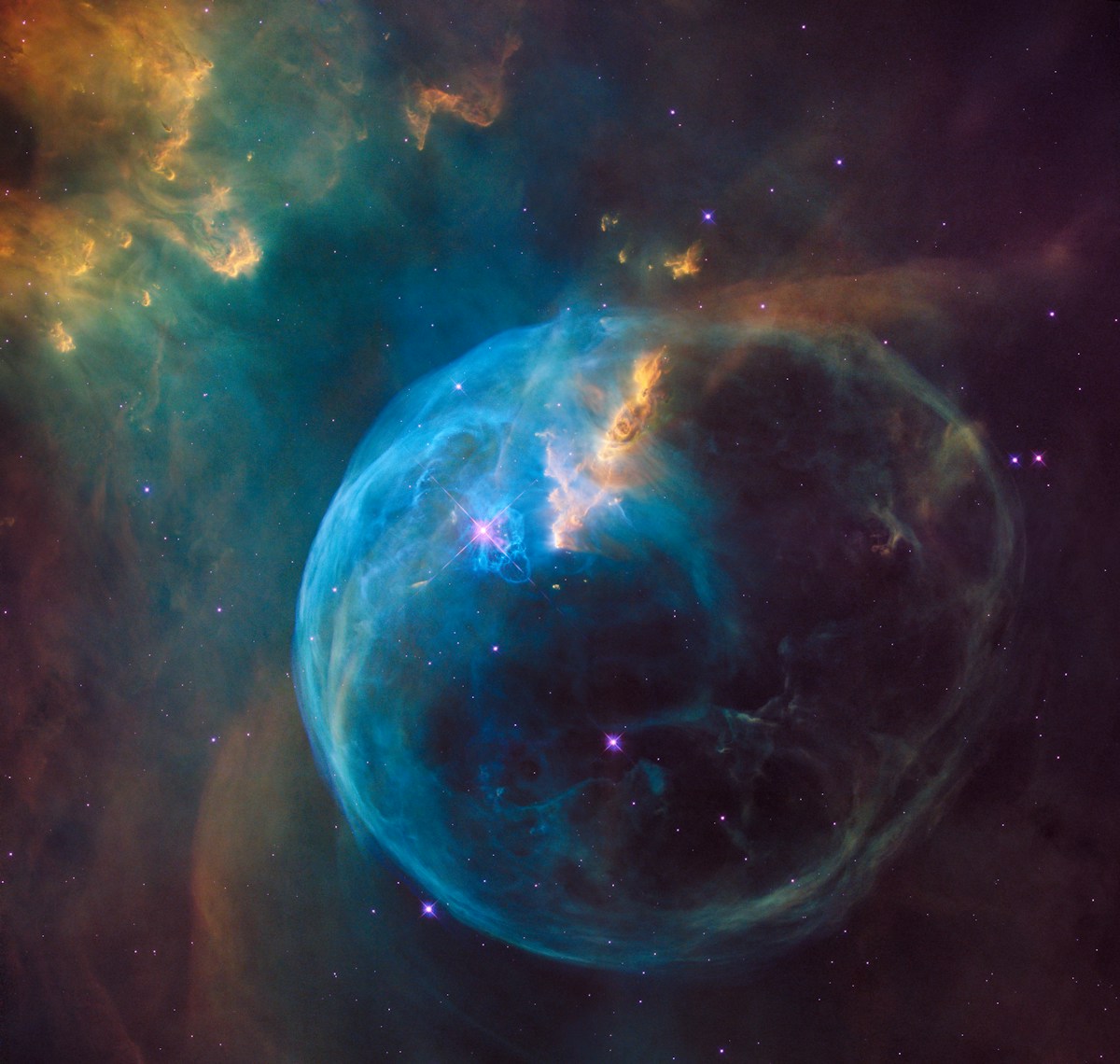
Elsewhere in the image, a bright blue nebula is lit by a protostar surrounded by a torus-shaped disc of material, with outflows visible nearby. Webb's sharp optics also revealed rich filaments of gas and dust and many background galaxies shining through the nursery — a reminder that every deep image looks through our galaxy to the universe beyond. Compared with Spitzer's view of the same region, the improvement is not subtle: structures that were smudges are now filaments, cavities and individual stars.
The W51 study, using NIRCam and MIRI, told a complementary story about massive star formation. Its long-wavelength infrared view revealed young, massive stars that previous telescopes had missed, along with atoms and molecules invisible at other wavelengths. The stars in W51 started forming relatively recently — within roughly the past million years — and are still forming now, which makes the region a live laboratory rather than a fossil.
Webb also revealed the violence of massive birth: giant bubbles blown by stellar winds, dark filaments of cold gas, ionised gas bubbles, and outflow knots left behind as massive stars interact with their surroundings. These features matter because massive stars, despite being rare, dominate their nurseries: their radiation and winds can both trigger and suppress further star formation, shaping how many stars a cloud ultimately produces and what masses they end up with.
When you look at a Webb image of a stellar nursery, start with colour: blue usually marks hot, exposed stars and their light, while red and orange mark cooler dust and gas. Look for cavities — dark, empty-looking bubbles — and ask what carved them: usually a massive star's wind or outflow. Look for bright knots along jets, which mark where a protostar's outflow is slamming into surrounding gas.
Then look for the smallest points of light buried in the dust: those are the youngest stars, some still accreting material from discs that may one day form planets. That is the deeper payoff of Webb's dust-penetrating vision. By seeing stars at the moment of birth, astronomers can test theories of how mass, radiation and environment decide whether a cloud makes a few giants or many small stars like our Sun — and, by extension, how common planetary systems like ours might be.
📖 Continue Reading the Full Story
Continue reading this article on FreeSky Cosmos.
⚡ Access Full Content NowMore from FreeSky Cosmos

 ⚡ CyberTech 568
Step-by-Step Tutorial: Playback Speed Calculator — Video Time at Any Speed (Day 2 Guide)
How to accurately use the Playback Speed Calculator — Video Time at Any Speed on CyberTech 568. Discover essen...
🤖 WinBar AI
Step-by-Step Tutorial: YouTube Thumbnail Downloader & Grabber — 4K (Day 2 Guide)
How to accurately use the YouTube Thumbnail Downloader & Grabber — 4K on WinBar AI. Discover essential practic...
 ☁️ FreeSky Cloud
ROI & Value Audit: GST Calculator — Add or Extract GST & VAT (Day 15 Guide)
How to save time and eliminate guesswork with GST Calculator — Add or Extract GST & VAT on FreeSky Cloud. Disc...
 🛰️ FreeSky Aerial
How to Shoot a Drone Hyperlapse: A Beginner's Step-by-Step Guide
A hyperlapse turns a slow drone flight into a spectacular rushing video. Pick a subject with a clear path, use...