What Is a Supernova? How Massive Stars Die and Seed New Worlds
- Primary Signal: What Is a Supernova? How Massive Stars Die and Seed New Worlds
- Overview: A supernova is the most violent explosion in the modern universe, briefly outshining an entire galaxy. It happens when a massive star runs out of fuel and collapses, and the debris...
- Verification: Analyzed and compiled by FreeSky Cosmos editorial monitoring desk.
A supernova is what happens when a star dies violently. For a few weeks, a single exploding star can shine brighter than the entire galaxy around it, releasing more energy than our Sun will produce in its whole ten-billion-year life. Ancient sky-watchers recorded these events as mysterious new stars that appeared without warning and then faded over months. Today we know they are the deaths of massive stars, and we also know something more remarkable: the calcium in your bones, the iron in your blood and the oxygen you are breathing were all forged in explosions like these.
There are two main ways to get a supernova. The first, and most common, is the core collapse of a massive star, one at least eight times the mass of the Sun. The second is a thermonuclear explosion, which happens when a dense stellar remnant called a white dwarf steals enough material from a companion star to cross a critical mass limit and detonate. The two types look different to astronomers and leave different remains behind, but both scatter newly made elements across space at a fair fraction of the speed of light.
The life and death of a massive star
A massive star spends most of its life fusing hydrogen into helium in its core, balancing the crushing inward pull of its own gravity against the outward pressure of the energy that fusion releases. When the hydrogen runs out, the core contracts and heats up until it can fuse helium into carbon, then carbon into heavier elements, building up layers like an onion: hydrogen on the outside, then helium, carbon, oxygen, silicon, and finally iron at the centre.
Iron is where the story ends, because fusing iron consumes energy instead of releasing it. With no new energy to hold it up, the core collapses in less than a second, from something the size of Earth to a ball barely 20 kilometres across. The outer layers crash inward and then rebound off the ultra-dense core in a shock wave that tears the star apart.
What is left behind
What remains depends on the mass of the collapsed core. If the core is below roughly two to three times the mass of the Sun, it becomes a neutron star, an object so dense that a teaspoon of its material would weigh around a billion tonnes. Neutron stars spin rapidly and often beam radio waves across space like cosmic lighthouses; these are the pulsars astronomers detect. If the core is heavier, nothing can stop the collapse, and it becomes a black hole, a region where gravity is so strong that not even light can escape.
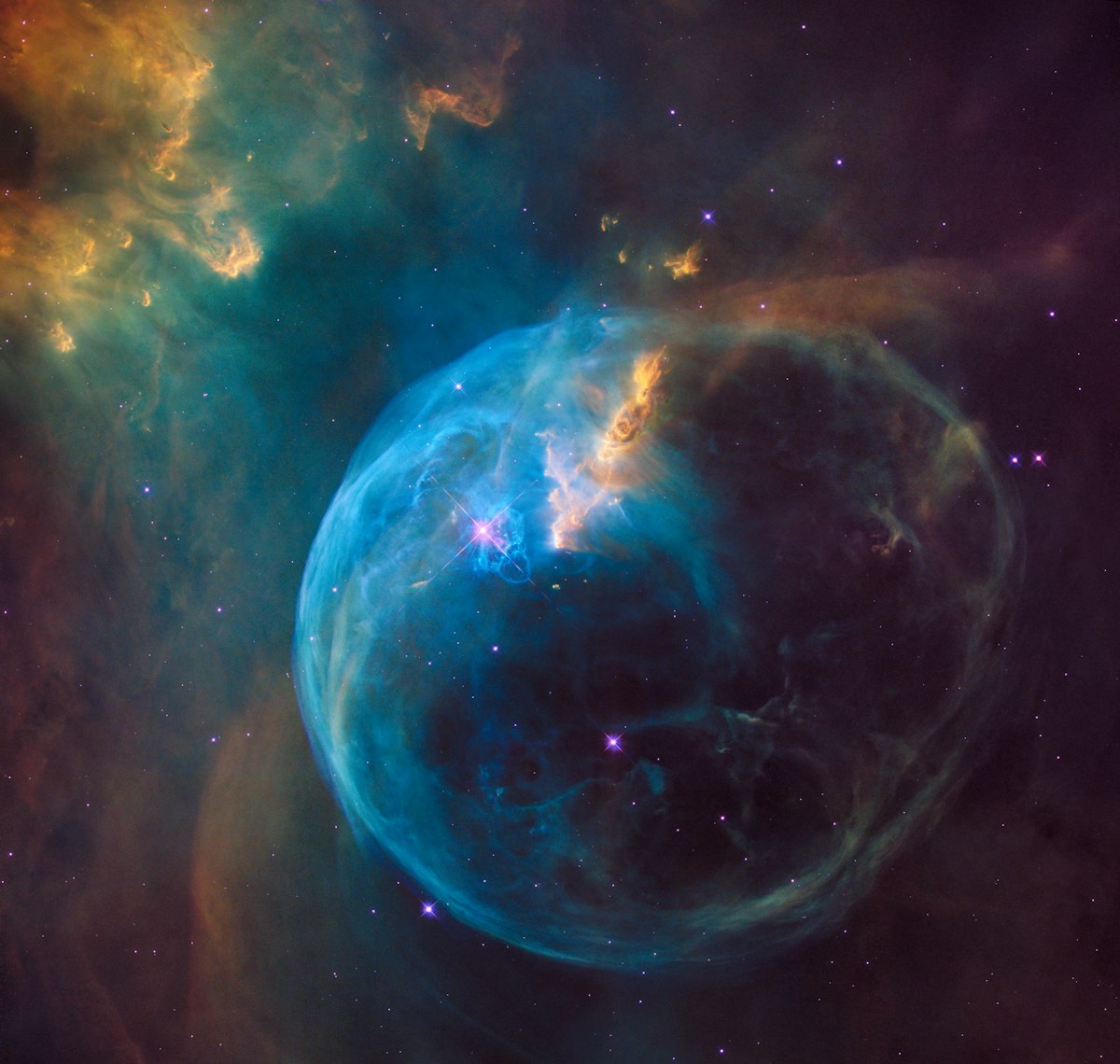
The expanding shell of gas left behind is called a supernova remnant, and it can glow for tens of thousands of years as it sweeps up the gas around it. The Crab Nebula is the remnant of a supernova seen by Chinese astronomers in 1054, and its heart still holds a pulsing neutron star. The famous Pillars of Creation and many other star-forming clouds were shaped, and in some cases triggered, by the shock waves of ancient supernovae compressing nearby gas until it collapsed into new stars.
Why supernovae matter to us
Supernovae are the main reason the universe contains anything more complicated than hydrogen and helium. The Big Bang made almost nothing heavier than helium, and ordinary stars can only build elements up to iron. Every atom heavier than iron in your body, your phone and the ground beneath your feet was made in a supernova, or in the collision of two neutron stars, which is a closely related event. When astronomers say we are made of star stuff, this is the literal truth, and supernovae are the delivery mechanism.
They are also one of astronomy's most important measuring tools. Type Ia supernovae, the white dwarf explosions, all reach nearly the same peak brightness, which makes them standard candles: if you know how bright something really is and how bright it looks, you can work out how far away it is. In the late 1990s, measurements of distant Type Ia supernovae revealed that the expansion of the universe is speeding up, a discovery that won the Nobel Prize and introduced the mystery of dark energy. A star's death, it turns out, can illuminate the fate of the whole universe.
Frequently Asked Questions
Q: How often does a supernova happen in our galaxy?
A: Astronomers estimate a supernova goes off in the Milky Way roughly once every few decades on average, but most are hidden behind dust clouds, so the last one clearly seen from Earth was in 1604.
Q: Could a nearby supernova harm Earth?
A: A supernova would need to be within roughly 50 light-years to seriously damage our ozone layer, and no star that close is massive enough or near enough to the end of its life to be a threat.
Q: What is the difference between a supernova and a nova?
A: A nova is a smaller surface explosion on a white dwarf that leaves the star intact and can repeat. A supernova destroys or fundamentally transforms the star, and it is millions of times more energetic.
📖 Continue Reading the Full Story
Continue reading this article on FreeSky Cosmos.
⚡ Access Full Content NowMore from FreeSky Cosmos


 🎉 FreeFortune Rewards
Cashback Apps That Pay Real Money in 2026: 7 Picks Worth Your Phone Space
Not every cashback app is worth installing, but a handful have long payout records and genuinely free tiers. H...
 📊 Try2Rich Capital
Startup Funding News Today, September 3, 2026: Backbone, Plenti, Rightcharge Outlier Space, Zeit AI, & More
Venture capital is shifting toward specialized AI, physical infrastructure, and software embedded in complex o...
 ⚡ CyberTech 568
Step-by-Step Tutorial: Playback Speed Calculator — Video Time at Any Speed (Day 2 Guide)
How to accurately use the Playback Speed Calculator — Video Time at Any Speed on CyberTech 568. Discover essen...
🤖 WinBar AI
Step-by-Step Tutorial: YouTube Thumbnail Downloader & Grabber — 4K (Day 2 Guide)
How to accurately use the YouTube Thumbnail Downloader & Grabber — 4K on WinBar AI. Discover essential practic...