What Is a Quasar? The Brightest Beacons in the Universe Explained
- Primary Signal: What Is a Quasar? The Brightest Beacons in the Universe Explained
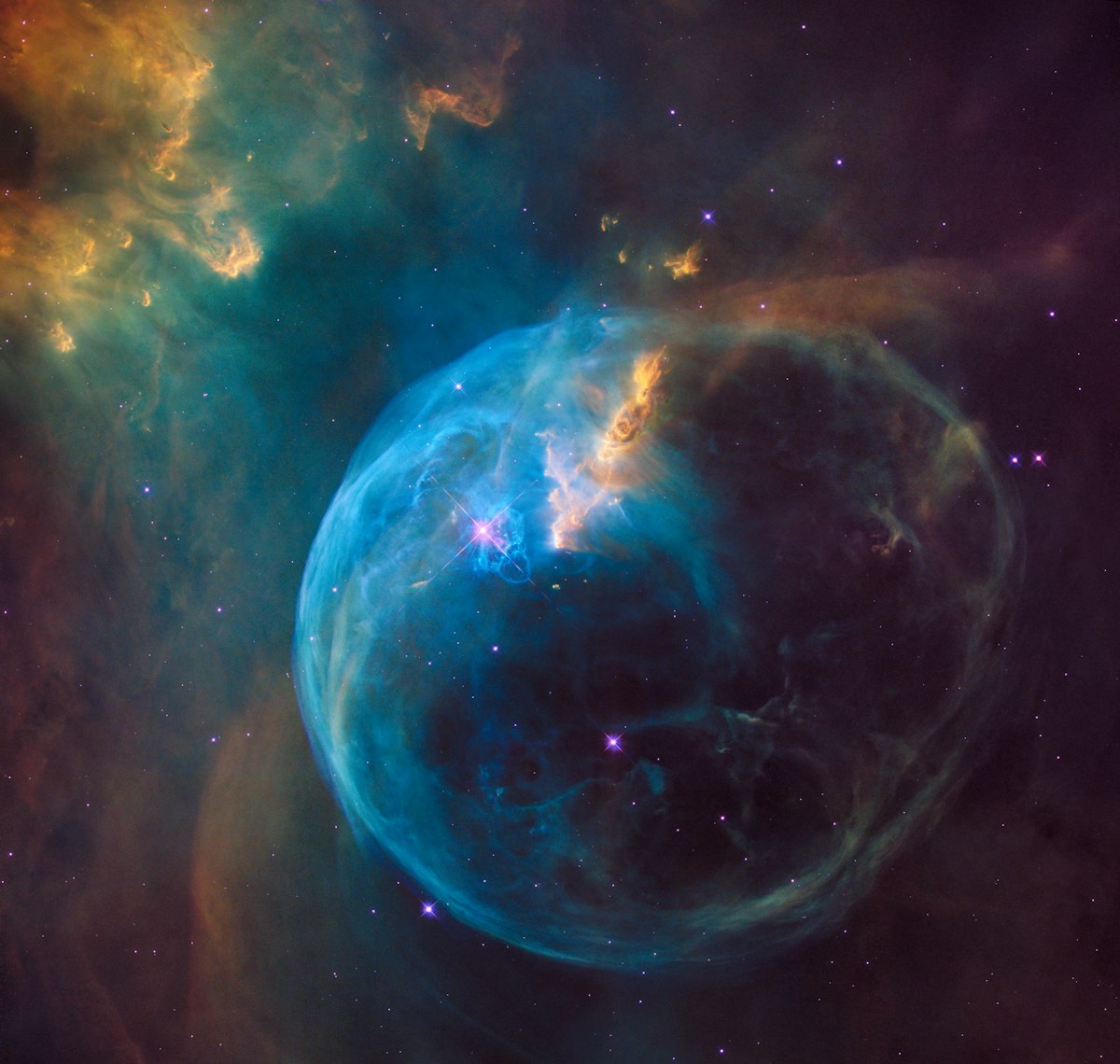
- Overview: A quasar is a supermassive black hole feeding so violently that it outshines its entire host galaxy. They are the brightest objects in the universe, visible across billions of ligh...
- Verification: Analyzed and compiled by FreeSky Cosmos editorial monitoring desk.
A quasar is the brightest thing in the universe, and it is powered by the darkest. At the centre of a quasar sits a supermassive black hole, millions or billions of times the mass of the Sun, pulling in surrounding gas at a ferocious rate. As the gas spirals inward it heats to millions of degrees and glows so fiercely that the tiny region around the black hole can outshine the entire galaxy that hosts it, sometimes by a factor of a thousand.
Quasars were a mystery when they were first found in the early 1960s. They looked like ordinary stars in photographs, just points of light, but their spectra showed that their light was stretched far more than any star's should be. That stretching, called redshift, meant they were enormously distant and therefore enormously luminous. The word quasar itself is short for quasi-stellar radio source, because the first ones found were strong radio emitters, though we now know many quasars are quiet in radio waves and shine brightest in visible and ultraviolet light.
How a black hole makes light
It sounds like a contradiction: a black hole is famous for letting nothing escape, yet a quasar is the brightest object in existence. The light does not come from inside the black hole. It comes from the material falling toward it. Gas spiralling inward forms a flattened, spinning disc called an accretion disc, and friction inside that disc heats the gas to millions of degrees.
Some quasars also fire jets of particles from their poles, streams of matter accelerated to nearly the speed of light by magnetic fields twisted by the spinning black hole. These jets can stretch for hundreds of thousands of light-years, far beyond the host galaxy, and they are among the largest structures produced by a single object anywhere in the universe. The jets also regulate the quasar itself: they can blow gas out of the galaxy and choke off the black hole's food supply, which eventually shuts the quasar down.
Quasars as cosmic lighthouses
Quasars are more than spectacular objects in their own right. They are tools. Because they are so bright and so distant, their light passes through enormous stretches of the universe on its way to us, and every cloud of gas it crosses leaves a fingerprint in the spectrum. By reading those fingerprints, astronomers can map the distribution of hydrogen and other elements across billions of years of cosmic history, tracing how galaxies formed and how the gas between them was ionised. A quasar is like a lighthouse shining through fog: the beam itself is not the point, it is what the beam reveals.
Quasars also anchor our understanding of how galaxies and their central black holes grow together. Almost every large galaxy, including our Milky Way, hosts a supermassive black hole at its centre, but most are quiet today, starved of gas. The quasars we see are those black holes in their feeding youth, when the universe was younger and galaxies were rich with gas. The relationship between a black hole's mass and the mass of its host galaxy is remarkably tight, which tells astronomers that black holes and galaxies grew up together, regulating each other through the very jets and winds that quasars produce.
The most distant quasars and the early universe
The most distant quasars known are seen as they were less than a billion years after the Big Bang, and they pose a puzzle: how did black holes grow to billions of solar masses so quickly? A black hole feeding at the maximum possible rate would need nearly the whole age of the universe at that time to reach such a size, which suggests they either started from unusually large seeds or fed faster than the usual limits allow. The James Webb Space Telescope is now finding more of these early quasars and their host galaxies, and each one tightens the constraints on how the first black holes formed.
Most quasars have long since faded. As the universe expanded and galaxies used up or expelled their gas, the black holes at their centres ran out of fuel and went quiet. The Milky Way's own central black hole, Sagittarius A*, is about four million times the mass of the Sun, but it is currently dormant, glowing only faintly. It may have been a quasar billions of years ago. When astronomers look at a quasar today, they are looking at the young, violent phase of a galaxy much like our own.
Frequently Asked Questions
Q: What is the difference between a quasar and a black hole?
A: A quasar is not a separate object from a black hole. It is a phase: a supermassive black hole that is actively feeding on gas, with the glowing accretion disc around it producing the quasar's light.
Q: How far away is the nearest quasar?
A: The nearest known quasar is about 600 million light-years away. Most quasars are billions of light-years distant because they were most common in the early universe.
Q: Can we see quasars with a backyard telescope?
A: A few of the brightest quasars, such as 3C 273, are within reach of a modest amateur telescope under a dark sky, though they look like faint, ordinary stars. Their true nature is only revealed by their spectra.
📖 Continue Reading the Full Story
Continue reading this article on FreeSky Cosmos.
⚡ Access Full Content NowMore from FreeSky Cosmos


 🎉 FreeFortune Rewards
Cashback Apps That Pay Real Money in 2026: 7 Picks Worth Your Phone Space
Not every cashback app is worth installing, but a handful have long payout records and genuinely free tiers. H...
 📊 Try2Rich Capital
Startup Funding News Today, September 3, 2026: Backbone, Plenti, Rightcharge Outlier Space, Zeit AI, & More
Venture capital is shifting toward specialized AI, physical infrastructure, and software embedded in complex o...
 ⚡ CyberTech 568
Step-by-Step Tutorial: Playback Speed Calculator — Video Time at Any Speed (Day 2 Guide)
How to accurately use the Playback Speed Calculator — Video Time at Any Speed on CyberTech 568. Discover essen...
🤖 WinBar AI
Step-by-Step Tutorial: YouTube Thumbnail Downloader & Grabber — 4K (Day 2 Guide)
How to accurately use the YouTube Thumbnail Downloader & Grabber — 4K on WinBar AI. Discover essential practic...