NASA’s SPHEREx Telescope Sees Menagerie of Brown Dwarfs
Story summary
NASA’s SPHEREx (Spectro-Photometer for the History of the Universe, Epoch of Reionization, and Ices Explorer) space telescope is shedding light on brown dwarfs, celestial objects that blur the line between stars and exoplanets. New findings published in The Astrophysical Journal show that these dark
📌 Key Highlights & Takeaways
- NASA’s SPHEREx (Spectro-Photometer for the History of the Universe, Epoch of Reionization, and Ices Explorer) space telescope is shedding light on brown dwarfs, celestial objects that blur the line between stars and exoplanets.
- New findings published in The Astrophysical Journal show that these dark
NASA’s SPHEREx (Spectro-Photometer for the History of the Universe, Epoch of Reionization, and Ices Explorer) space telescope is shedding light on brown dwarfs, celestial objects that blur the line between stars and exoplanets. New findings published in The Astrophysical Journal show that these dark and cloudy worlds have chemically rich atmospheres not unlike the giant planets in our own solar system.
First discovered in the 1990s, brown dwarfs form from collapsing clouds of gas, like stars do, but they aren’t hefty enough to sustain hydrogen fusion in their cores. These dimly glowing balls of warm gas also share characteristics with Jupiter and Saturn. In contrast to most planets, however, brown dwarfs drift in darkness, ungoverned by a host star and heated entirely from within.
“They’re kind of goth,” said Zafar Rustamkulov, lead author of the new study and a scientist at IPAC, Caltech’s science and data center in Pasadena, California. “Unlike exoplanets , free-floating brown dwarfs are completely independent celestial objects that will fade into eternity alone. We’re still learning how complex they are.”
Only a few dozen of these “dark wanderers” have been studied in detail with space-based telescopes. Astronomers want to observe more of them in the wild because much of our understanding of their makeup, storminess, and evolution comes from theoretical models.
Enter NASA’s SPHEREx , an infrared space telescope launched in March 2025 and managed by the agency’s Jet Propulsion Laboratory in Southern California.
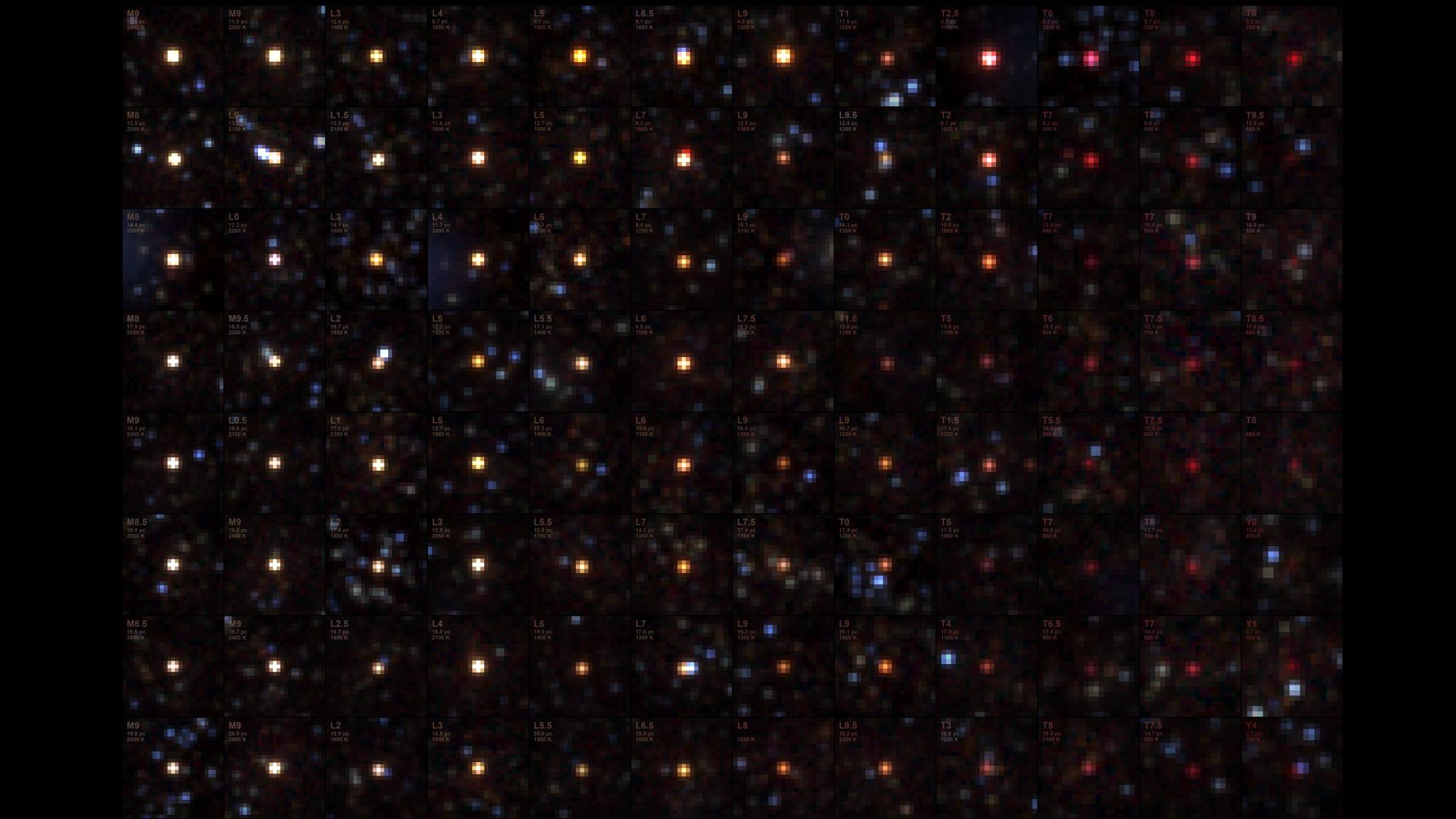
The study authors analyzed SPHEREx observations of 37 nearby brown dwarfs spanning the full brown dwarf temperature range, from about 4,000 to minus 10 degrees Fahrenheit (2,200 to minus 20 degrees Celsius). The telescope measures their brightness in 102 different colors, from the deepest red our eyes can see, to the invisible heat of infrared light, creating a spectrum . These spectra revealed to the study authors chemically rich atmospheres harboring water, carbon dioxide, carbon monoxide, and methane.
“We’re seeing the signatures of these molecules and how they change from object to object across the entire temperature regime,” said study coauthor J. Davy Kirkpatrick, a scientist at Caltech’s IPAC. “Our paper concentrated on just three dozen, but we have thousands more that we are in the process of analyzing. I really want to see what bounds the universe places on the variety of brown dwarfs.”
“From orbit, SPHEREx sees wavelengths of light that are basically impossible to see with telescopes on the ground because water in Earth’s atmosphere absorbs them,” Rustamkulov said. “We are picking up light from the deep, red clouds of brown dwarfs all over the sky.”
Editorial Text & Content Analyzer
Analyze real-time word count, reading speed, and text density metrics on the fly.
Source: NASA.
Read the full story at the original source ↗
For questions: mrsmithcons@gmail.com.
❓ Frequently Asked Questions (James Webb Intel Briefing)
What orbital telemetry or sensor data corroborates this James Webb Intel discovery?
Multi-spectral satellite imagery, radar altimetry, and space agency observational feeds provide calibrated observational data confirming the parameters of this event.
How does this observation impact current aerospace and geospatial modeling?
The recorded metrics refine atmospheric correction algorithms and orbital ephemeris models, enabling higher resolution tracking and trajectory accuracy.
When is the next telemetry downlink or public briefing scheduled?
Real-time space agency mission updates and satellite overpass data are ingested continuously through FreeSky Cosmos tracking desks.
🔭 Full 4K Astrophotography Dossier & Scientific Analysis
Raw multi-band infrared composite data, spectral graphs, and mission notes.
⚡ Access Cosmic Dossier ➔More from FreeSky Cosmos
 🤖 WinBar AI
Sports Betting AI Agent: How Conversational Intelligence Is Reshaping the Bettor Experience in 2026
Breaking coverage reported by DailyGame: Sports Betting AI Agent: How Conversational Intelligence Is Reshaping...
 🗺️ FreeSky GeoData
Боброво-коричневые воды в заливе Руперт
Растворенные органические вещества и взвешенные отложения смешиваются в самой южной части залива Джеймс....
Meta Leads AI Agent Standards
Meta and other companies are backing a personal-agent protocol to authenticate AI agents and clarify access to...
 ☁️ FreeSky Cloud
Essential Blueprint: How Leaders Are Navigating Free SaaS Tiers for High-Yield Performance in 2026
Comprehensive 2026 editorial analysis exploring Free SaaS Tiers on FreeSky Cloud. Discover key strategic frame...