Брифинг НАСА, посвященный вкладу в миссию по марсианским лунам
Story summary
Представители СМИ приглашаются присоединиться к НАСА на телеконференции для СМИ в 16:00. По восточному времени, в четверг, 15 октября, будет представлен обзор вклада агентства в миссию JAXA (Японского агентства аэрокосмических исследований) по исследованию марсианских лун (MMX). Миссию планируется запустить с космодрома Танегасима JAXA в Японии.
📌 Key Highlights & Takeaways
- Представители СМИ приглашаются присоединиться к НАСА на телеконференции для СМИ в 16:00.
- По восточному времени, в четверг, 15 октября, будет представлен обзор вклада агентства в миссию JAXA (Японского агентства аэрокосмических исследований) по исследованию марсианских лун (MMX).
- Миссию планируется запустить с космодрома Танегасима JAXA в Японии.
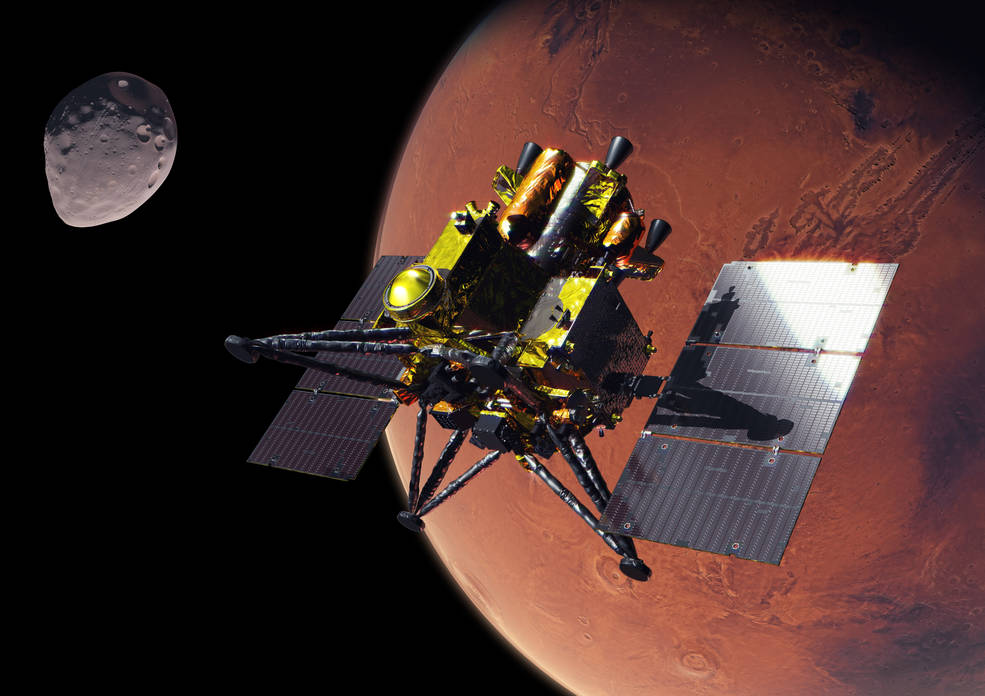
Media are invited to join NASA for a media teleconference at 4 p.m. EDT, Thursday, Oct. 15, to preview the agency’s contributions to JAXA’s (Japan Aerospace Exploration Agency) Martian Moons eXploration (MMX) mission. The mission is scheduled to launch from JAXA’s Tanegashima Space Center in Japan on Monday, Oct. 19 EDT (Tuesday, Oct. 20 JST).
Audio of the media teleconference will stream on the agency’s website at:
Participants in the briefing, who will provide an overview of the mission and NASA’s contributions, include:
Media interested in participating by phone must RSVP no later than two hours prior to the start of the teleconference to Molly Wasser at molly.l.wasser@nasa.gov . A copy of NASA’s media accreditation policy is online.
The MMX spacecraft will arrive at Mars in August 2027 to begin its survey of the Red Planet’s two moons, Phobos and Deimos. After surveying Phobos in detail, the spacecraft will collect a sample of the moon’s surface no earlier than December 2028 and deliver it to Earth in 2031. NASA’s contributions to the mission include the MEGANE gamma-ray and neutron spectrometer, the spacecraft’s surface sampler mechanism, and communications and navigation support from the agency’s Deep Space Network , as well as funding United States scientists participating on the MMX science team.
The MEGANE instrument was developed by Johns Hopkins Applied Physics Laboratory. Honeybee Robotics, a Blue Origin company, developed the spacecraft’s pneumatic sampler mechanism. NASA’s contributions to the MMX mission were funded by the agency’s Discovery Program, which provides frequent flight opportunities for high-value, focused planetary science investigations. The Discovery Program is managed by NASA’s Marshall Space Flight Center in Huntsville, Alabama, for the agency’s Science Mission Directorate in Washington.
For more information about the MMX mission, visit:
https://science.nasa.gov/mission/mmx/
Editorial Text & Content Analyzer
Analyze real-time word count, reading speed, and text density metrics on the fly.
Source: NASA.
Read the full story at the original source ↗
For questions: mrsmithcons@gmail.com.
More from FreeSky Cosmos