Webb Measures Distance to Farthest Fast Radio Burst, Suggesting Origin
Story summary
First discovered in 2007, fast radio bursts are enigmatic, millisecond-long flashes of radio emission from the distant universe. Their origin remains uncertain, particularly since most are seen once and never again. Astronomers using NASA’s James Webb Space Telescope have pinpointed the host galaxy
📌 Key Highlights & Takeaways
- First discovered in 2007, fast radio bursts are enigmatic, millisecond-long flashes of radio emission from the distant universe.
- Their origin remains uncertain, particularly since most are seen once and never again.
- Astronomers using NASA’s James Webb Space Telescope have pinpointed the host galaxy
Latest News Latest Images Webb’s Blog Awards X (offsite – login reqd) Instagram (offsite – login reqd) Facebook (offsite- login reqd) Youtube (offsite) Overview About Who is James Webb? Fact Sheet Impacts+Benefits FAQ Webb Timeline Science Overview and Goals Early Universe Galaxies Over Time Star Lifecycle Other Worlds Science/Engineering Explainers Observatory Overview Launch Deployment Orbit Mirrors Sunshield Instruments & ISIM Module Instrument: NIRCam Instrument: MIRI Instrument: NIRSpec Instrument: FGS/NIRISS Optical Telescope Element Backplane Spacecraft Bus Webb vs Hubble -> Multimedia About Webb Images Images Videos Products & Activities Podcasts Webb Image Sonifications What is Webb Observing? 3d Webb in 3d Solar System Webb’s First Images Team International Team People Of Webb More For the Media For Scientists For Educators For Fun/Learning 5 Min Read Webb Measures Distance to Farthest Fast Radio Burst, Suggesting Origin
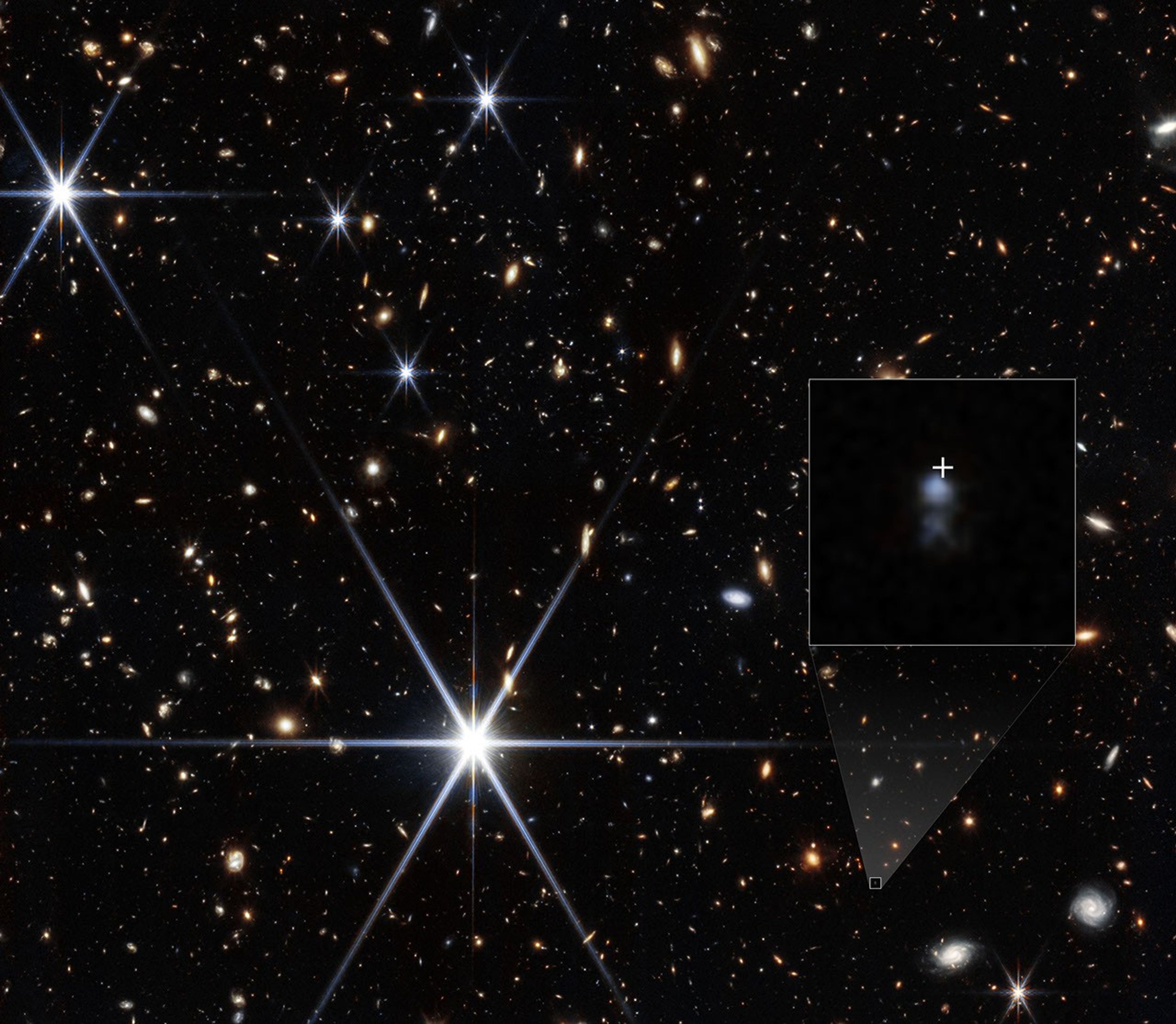
First discovered in 2007, fast radio bursts are enigmatic, millisecond-long flashes of radio emission from the distant universe. Their origin remains uncertain, particularly since most are seen once and never again. Astronomers using NASA’s James Webb Space Telescope have pinpointed the host galaxy of the most distant fast radio burst (FRB) seen to date. Their finding has implications for what kind of energetic event creates these bursts.
“What makes fast radio bursts interesting is that we don’t know what generates them. We have theories for what objects produce them, but we don’t have conclusive proof,” said Manisha Caleb of the University of Sydney, lead author on the study published Thursday in the journal Science .
The MeerTRAP team used the MeerKAT telescope to detect the burst on March 4, 2024, leading to its designation as FRB 20240304B. The radio data from this burst suggested that it was extremely distant, possibly the most distant one seen to date. To confirm that distance, though, astronomers would need to study its host galaxy. Although they knew the location of the FRB very precisely, the world’s largest ground-based telescopes could not see any galaxy at that spot in the sky. As a result, the team turned to the Webb telescope.
Webb’s NIRCam (Near-Infrared Camera) instrument detected a galaxy in the right location, and its NIRSpec (Near-Infrared Spectrograph) instrument provided a precise measurement of the galaxy’s redshift : 2.148, corresponding to a time just 3 billion years after the big bang. The vast majority of FRBs detected to date occurred billions of years later in cosmic history.
The team discovered that the host galaxy of FRB 20240304B was not typical of other galaxies with FRBs. Most FRB galaxies are massive star-forming galaxies, but the galaxy they found was 1,000 times less massive than they expected.
“We thought it would be a big, nicely formed galaxy with lots of stars, and instead it was a little dwarf galaxy, although it was actively forming stars,” said Caleb.
“The host sticks out in the whole galaxy sample that we have. And it definitely was not what we were expecting,” said Ben Stappers of the University of Manchester, United Kingdom, a co-author on the paper. “This combination of using the MeerTRAP project on the MeerKAT telescope to discover and localize these distant bursts and Webb to study their hosts is very exciting.”
Editorial Text & Content Analyzer
Analyze real-time word count, reading speed, and text density metrics on the fly.
Source: NASA.
Read the full story at the original source ↗
For questions: mrsmithcons@gmail.com.
❓ Frequently Asked Questions (James Webb Intel Briefing)
What orbital telemetry or sensor data corroborates this James Webb Intel discovery?
Multi-spectral satellite imagery, radar altimetry, and space agency observational feeds provide calibrated observational data confirming the parameters of this event.
How does this observation impact current aerospace and geospatial modeling?
The recorded metrics refine atmospheric correction algorithms and orbital ephemeris models, enabling higher resolution tracking and trajectory accuracy.
When is the next telemetry downlink or public briefing scheduled?
Real-time space agency mission updates and satellite overpass data are ingested continuously through FreeSky Cosmos tracking desks.
🔭 Full 4K Astrophotography Dossier & Scientific Analysis
Raw multi-band infrared composite data, spectral graphs, and mission notes.
⚡ Access Cosmic Dossier ➔More from FreeSky Cosmos
 🤖 WinBar AI
Sports Betting AI Agent: How Conversational Intelligence Is Reshaping the Bettor Experience in 2026
Breaking coverage reported by DailyGame: Sports Betting AI Agent: How Conversational Intelligence Is Reshaping...
Meta Leads AI Agent Standards
Meta and other companies are backing a personal-agent protocol to authenticate AI agents and clarify access to...
 ☁️ FreeSky Cloud
Essential Blueprint: How Leaders Are Navigating Free SaaS Tiers for High-Yield Performance in 2026
Comprehensive 2026 editorial analysis exploring Free SaaS Tiers on FreeSky Cloud. Discover key strategic frame...
 🛰️ FreeSky Aerial
Essential Blueprint: How Leaders Are Navigating Rocket Launches for High-Yield Performance in 2026
Comprehensive 2026 editorial analysis exploring Rocket Launches on FreeSky Aerial. Discover key strategic fram...