Griffin-1 da Voyager Technologies conclui testes ambientais no JPL da NASA
Story summary
Descrição Um módulo lunar da Voyager Technologies completou quase três meses de testes ambientais no Laboratório de Propulsão a Jato da NASA, no sul da Califórnia, no final de setembro de 2026. Os testes demonstram que a espaçonave está preparada para enfrentar as duras condições de lançamento, sua jornada para
📌 Key Highlights & Takeaways
- Descrição Um módulo lunar da Voyager Technologies completou quase três meses de testes ambientais no Laboratório de Propulsão a Jato da NASA, no sul da Califórnia, no final de setembro de 2026.
- Os testes demonstram que a espaçonave está preparada para enfrentar as duras condições de lançamento, sua jornada para
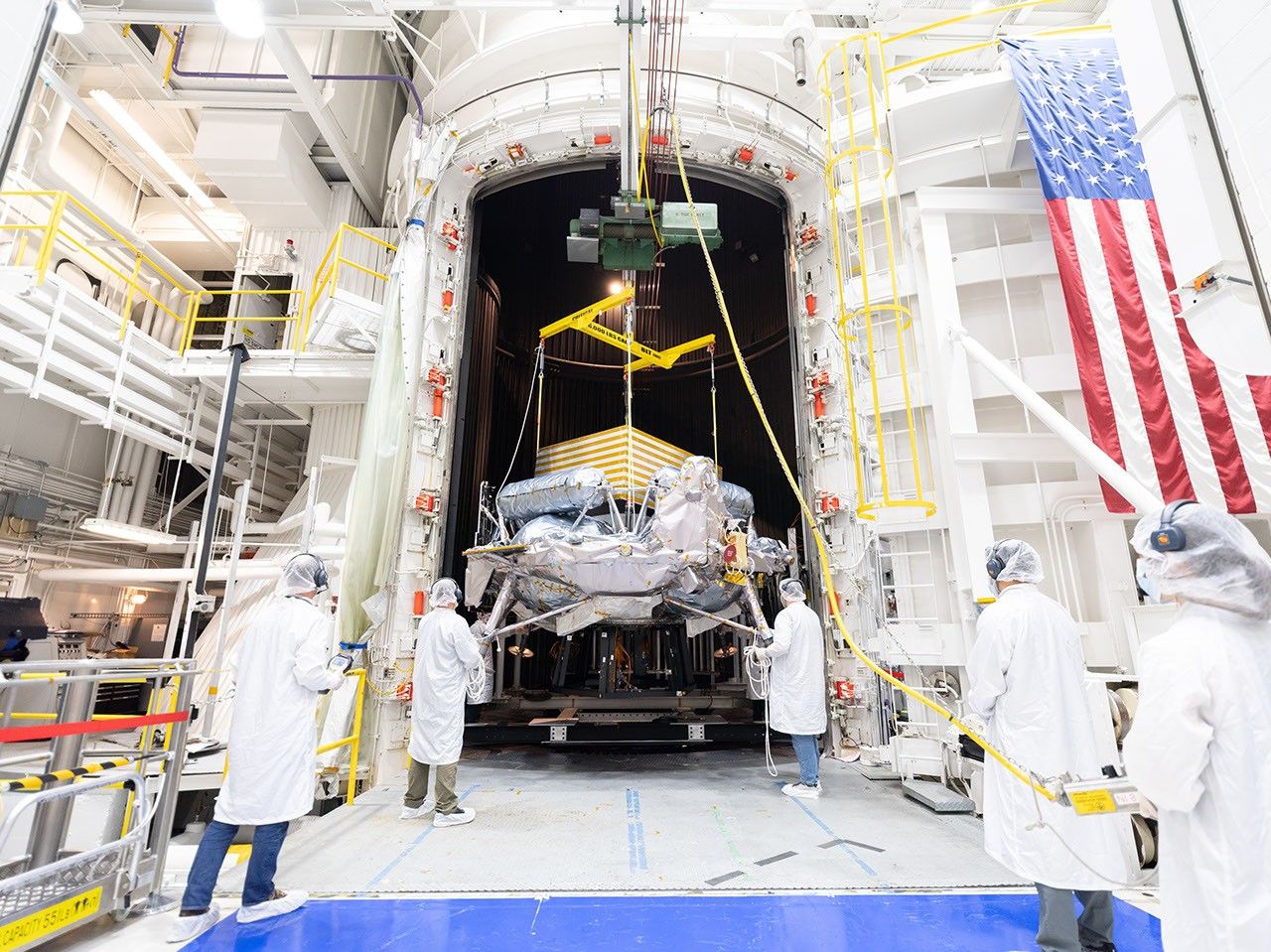
A lunar lander from Voyager Technologies completed nearly three months of environmental testing at NASA’s Jet Propulsion Laboratory in Southern California in late September 2026. The tests demonstrate that the spacecraft is prepared to face the harsh conditions of launch, its journey to the Moon, and landing on the surface. Its final trial was in JPL’s historic 25-Foot Space Simulator, a thermal vacuum chamber listed on the National Register of Historic Places for its role in supporting historic missions like those of the Ranger, Surveyor, Mariner, and Voyager programs.
Engineers and technicians on Aug. 31, 2026, used a crane to position the spacecraft within the towering chamber, where Griffin-1 alternately baked at up to 167 degrees Fahrenheit (75 degrees Celsius) and froze at temperatures as low as minus 148 F (minus 100 C). This thermal vacuum testing simulates the extreme temperatures the spacecraft will experience during its mission. The yellow-striped box atop the lander simulates a payload that will later be attached to the spacecraft: Astrolab’s FLIP (FLEX Lunar Innovation Platform) rover.
In Figure A, engineers and technicians move Griffin-1 through a hallway leading to the 25-Foot Space Simulator on Aug. 31. The corridor is lined with photographs of some of the historic spacecraft that have been tested in the facility since the 1960s.
Figure B shows Griffin-1 on July 29 in an anechoic chamber for electromagnetic interference and electromagnetic compatibility testing, which ensures signals from the spacecraft’s electronic components don’t interfere with one another. Long foam spikes line the chamber walls to absorb sound waves and electromagnetic waves.
In Figure C, taken on July 20, Griffin-1 rotates rapidly on a special table to measure its mass properties, enabling engineers to look for any unexpected wobbles as they assess how the vehicle will move through space — vital information for determining the spacecraft’s readiness for flight and surface operations.
In Figure D, microphones are arrayed around Griffin-1 on Aug. 12 during acoustic testing in which giant horns powered by compressed gaseous nitrogen blast the spacecraft with up to 153 decibels inside the sealed acoustic chamber to mimic the roar of launch.
Griffin-1 also endured vibration testing, during which hundreds of sensors monitored the spacecraft as a “shaker table” rattled it in three directions — with increasingly intense force — to simulate the ride out of Earth’s atmosphere atop a rocket.
After proving its mettle at JPL, Griffin-1 was shipped back across the country to Voyager Lunar Systems’ Pittsburgh facility for final assembly. Part of NASA’s CLPS (Commercial Lunar Payload Services) initiative within the Moon Base Program, Griffin-1 is expected to launch in late 2026 aboard a SpaceX Falcon Heavy rocket. The infrastructure-class lander will deliver more than 1,100 pounds (455 kilograms) of cargo — 10 payloads from six countries — to Nobile Crater near the lunar South Pole.
Cryptographic Security & Key Generator
Generate entropy-tested high-security keys and encryption-grade tokens.
Source: NASA.
Read the full story at the original source ↗
For questions: mrsmithcons@gmail.com.
❓ Frequently Asked Questions (James Webb Intel Briefing)
What orbital telemetry or sensor data corroborates this James Webb Intel discovery?
Multi-spectral satellite imagery, radar altimetry, and space agency observational feeds provide calibrated observational data confirming the parameters of this event.
How does this observation impact current aerospace and geospatial modeling?
The recorded metrics refine atmospheric correction algorithms and orbital ephemeris models, enabling higher resolution tracking and trajectory accuracy.
When is the next telemetry downlink or public briefing scheduled?
Real-time space agency mission updates and satellite overpass data are ingested continuously through FreeSky Cosmos tracking desks.
🔭 Full 4K Astrophotography Dossier & Scientific Analysis
Raw multi-band infrared composite data, spectral graphs, and mission notes.
⚡ Access Cosmic Dossier ➔More from FreeSky Cosmos
 ⚡ CyberTech 568
Flox Intelligence está construindo IA para manter a vida selvagem longe de trens, aeroportos e estradas
Os dispositivos de ponta da Flox podem identificar animais e usar sons específicos de espécies para afastá-los...
 🛰️ FreeSky Aerial
NASA realizará sobrevôo e envolverá fãs da NFL no MetLife Stadium
Como parte do sobrevôo do Inspiration Tour da agência, o administrador da NASA, Jared Isaacman, pilotará um do...
 🤖 WinBar AI
Meta is betting the house on AI — CFO warns the stakes are 'really bad' if it flops
Breaking coverage reported by AOL.com: Meta is betting the house on AI — CFO warns the stakes are 'really bad'...
 ☁️ FreeSky Cloud
Resumo semanal da AWS: Prime Day 2026 em números, Claude Haiku 5.5, Amazon Nova 2.5 Sonic e muito mais (13 de outubro de 2026)
Alguns números são difíceis de imaginar até que você os analise por um momento. Na semana passada, publicamos ...