NASA Discovery Reveals Complex Water Systems on Early Mars
Story summary
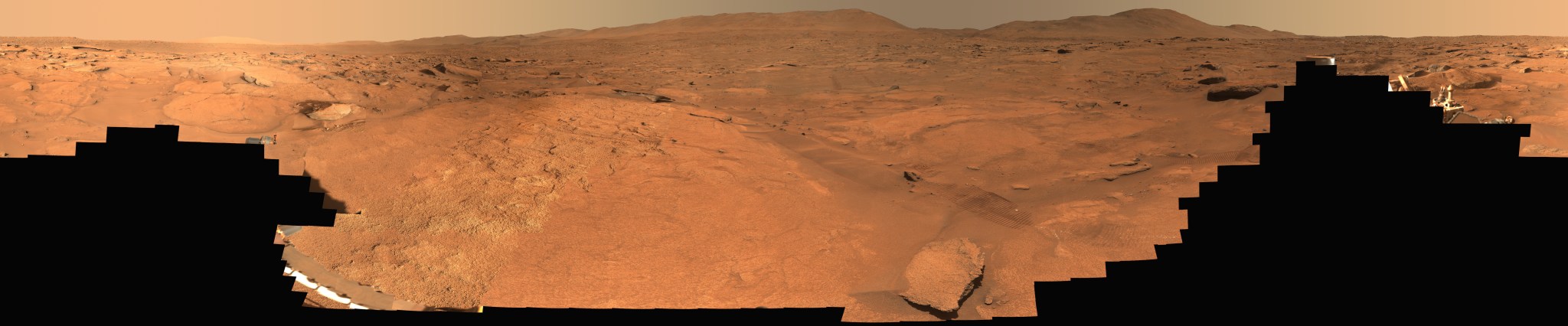
When NASA’s Perseverance rover reached the inner edge of Mars’ Jezero Crater in September 2023, mission scientists were surprised by what they found. Called the “Margin Unit,” the geologic area stretches along the shoreline of an ancient Martian lake, so they expected sedimentary rocks, which would
📌 Key Highlights & Takeaways
- When NASA’s Perseverance rover reached the inner edge of Mars’ Jezero Crater in September 2023, mission scientists were surprised by what they found.
- Called the “Margin Unit,” the geologic area stretches along the shoreline of an ancient Martian lake, so they expected sedimentary rocks, which would
When NASA’s Perseverance rover reached the inner edge of Mars’ Jezero Crater in September 2023, mission scientists were surprised by what they found. Called the “Margin Unit,” the geologic area stretches along the shoreline of an ancient Martian lake, so they expected sedimentary rocks, which would have formed as layers of sand piled on top of each other over millennia. Composed of clay and silt, sedimentary rocks on Earth are good at preserving past microbial life. The scientists were especially intrigued by strong signals of carbonate minerals detected by Mars orbiters. On Earth, carbonates frequently form in shallow ocean and lake environments capable of supporting life.
Instead, the rover team found igneous rock, which can form deep underground from magma or from volcanic activity at the surface. Igneous rocks are excellent record-keepers, particularly because mineral crystals within them preserve details about the precise moment they formed. In this case, they preserved an astonishingly complex record of water activity on early Mars. In fact, these rocks showed signs of having interacted with water on at least three separate occasions, with each encounter further altering their chemistry and appearance. The findings were published Monday in the journal Communications Earth & Environment.
The instrument behind the findings is SuperCam, which perches on the rover’s mast and determines the mineralogy of geologic features based on the light they reflect. When the science team spots an intriguing rock, they can send commands for SuperCam to fire its laser up to 21 feet (6.5 meters) away. The spectrum of the resulting plasma reveals the target’s chemistry. Perseverance has analyzed more than 185 bedrock targets across the unit this way.
“Before we arrived at the Margin Unit, the main hypothesis — derived from orbital observations — was that the carbonate seen from orbit formed from interaction with the lake that existed in Jezero Crater,” said Candice Bedford, a research scientist at Purdue University in West Lafayette, Indiana, and the study’s lead author. “But now we know that this location became a sort of crossroads for aqueous systems. The Margin Unit findings are important because Jezero Crater sits inside one of the largest exposures of carbonate on Mars, so what we learn here reaches well beyond this crater.”
Perseverance explored the Margin Unit across approximately 870 feet (265 meters) of elevation. At higher elevations, it found rock that was coarse-grained and crystalline — hallmarks of the mineral olivine — with almost no sign that water had ever touched it. Made of magnesium and iron, the area’s olivine unit formed in a body of magma deep underground, cooling slowly enough for its grains to grow large, and reached the surface only after the ground above it eroded away. Lower in the unit, on the lakebed, the rock looks transformed, as the olivine grains were fractured with silica between them.
Carbonate and silica minerals are an important signpost in the search for ancient life. When water interacts with olivine on Earth, the reaction can release hydrogen, which can be a food source for some microbes, and it leaves behind carbonate and silica, two minerals that lock in traces of the past existence of those microbes.
The Perseverance team can determine the sequence of the Margin Unit’s interactions with water, but not their age. On the first occasion water reached the rocks of the Margin Unit, carbon-dioxide-rich groundwater reacted with olivine, resulting in ridges of carbonate that run through the fractures in bedrock at low elevations. Today, these carbonate-filled fractures are left standing as the softer rock around them wears away.
The second time water reached the rocks may have been related to the lake that once existed in the crater.
Editorial Text & Content Analyzer
Analyze real-time word count, reading speed, and text density metrics on the fly.
Source: NASA.
Full-Resolution James Webb Deep Field Imagery, Exoplanet Science & Planetary Missions
Explore the frontiers of modern astrophysics: high-resolution James Webb Space Telescope images, Mars rover discoveries, and cosmological breakthroughs.
Inspect Deep Space ➔🔭 Full 4K Astrophotography Dossier & Scientific Analysis
Raw multi-band infrared composite data, spectral graphs, and mission notes.
⚡ Access Cosmic Dossier ➔More from FreeSky Cosmos

Why Scientists Are Trapping Impossible Particles to Build Unbreakable Quantum Computers
Discover how physicists are using bizarre quasi-particles called non-Abelian anyons in fractional quantum Hall...
 🤖 WinBar AI
RELATÓRIO: Aplicativo de jogos esportivos supostamente usa IA para atingir aqueles com maior probabilidade de perder dinheiro em apostas
Cobertura de última hora relatada por dailycaller.com: RELATÓRIO: Aplicativo de jogos de azar esportivos supos...
GSP067 | App Engine: Qwik Start - Python | Google Cloud
🚀 GSP067 – App Engine: Qwik Start - Python Learn how to test, modify, and deploy a Python web application usi...