APOD: 9 de octubre de 2026 – Cráter Stickney
Story summary
APOD Ciencia APOD APOD: 2026 9 de octubre… Archivo APOD de hoy Índice de envíos Buscar Calendario RSS Educación Acerca de Discutir APOD Astronomía Imagen del día ¡Descubre el cosmos! Cada día se presenta una imagen o fotografía diferente de nuestro fascinante universo, junto con una breve explicación escrita b
📌 Key Highlights & Takeaways
- APOD Ciencia APOD APOD: 2026 9 de octubre… Archivo APOD de hoy Índice de envíos Buscar Calendario RSS Educación Acerca de Discutir APOD Astronomía Imagen del día ¡Descubre el cosmos!
- Cada día se presenta una imagen o fotografía diferente de nuestro fascinante universo, junto con una breve explicación escrita b
Discover the cosmos! Each day a different image or photograph of our fascinating universe is featured, along with a brief explanation written by a professional astronomer.
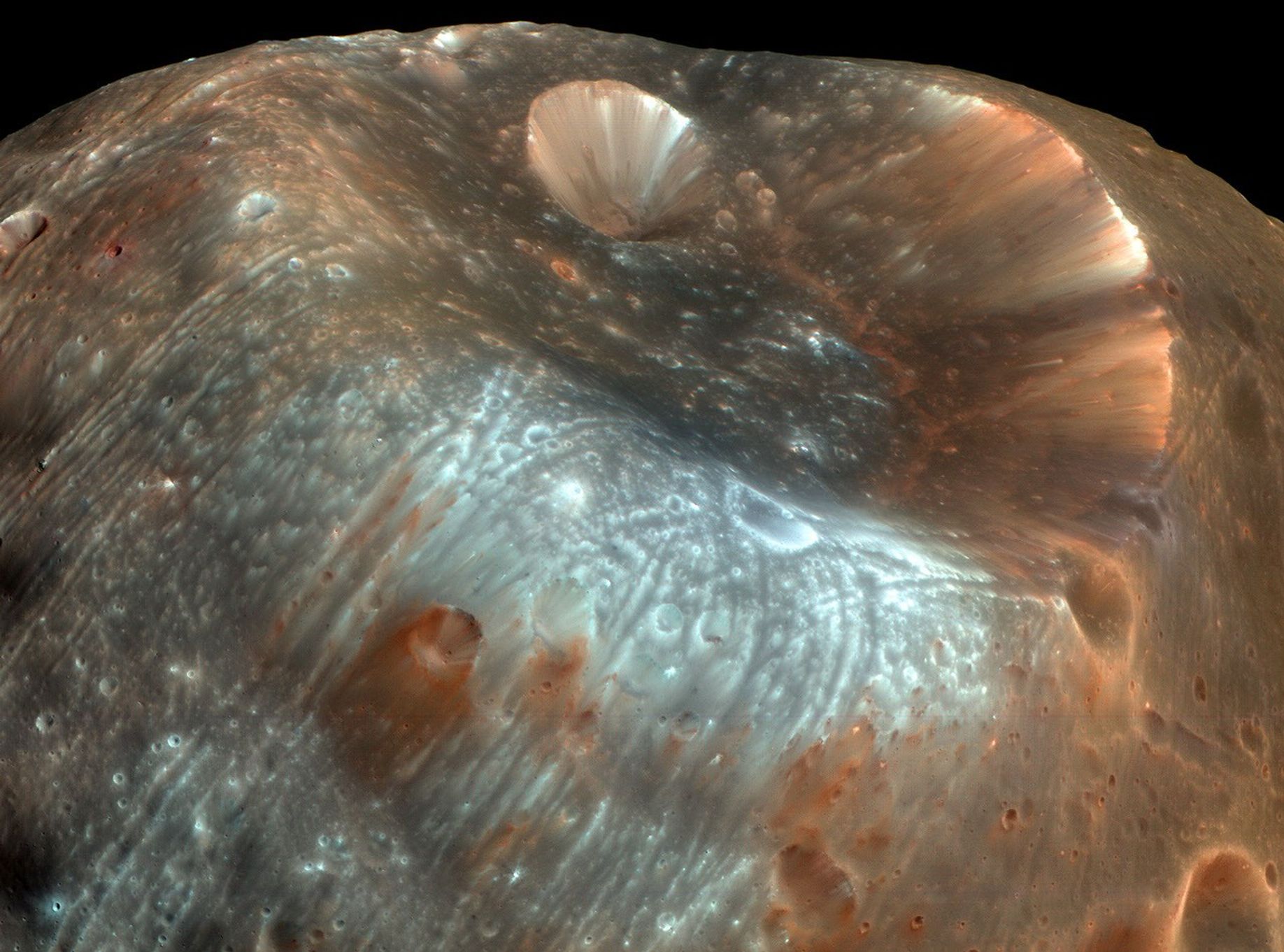
Explanation: Stickney Crater, the largest crater on the martian moon Phobos, is named for Chloe Angeline Stickney Hall, mathematician and wife of astronomer Asaph Hall. Asaph Hall discovered both the Red Planet’s moons in 1877. Over 9 kilometers across, Stickney is nearly half the diameter of Phobos itself, so large that the impact that blasted out the crater likely came close to shattering the tiny moon. This enhanced-color image of Stickney and surroundings was recorded by the HiRISE camera onboard the Mars Reconnaissance Orbiter as it passed within some six thousand kilometers of Phobos in March of 2008. Even though the surface gravity of asteroid-like Phobos is less than 1/1000th Earth’s gravity, streaks suggest loose material slid down inside the crater walls over time. Light bluish regions near the crater’s rim could indicate a relatively freshly exposed surface. The origin of the curious grooves along the surface is mysterious but may be related to tidal stresses experienced by close-orbiting Phobos or the crater-forming impact itself.
Yesterday’s Image APOD: 2026 October 8 – The Saturn System Smörgåsbord
Editorial Text & Content Analyzer
Analyze real-time word count, reading speed, and text density metrics on the fly.
Source: NASA.
Read the full story at the original source ↗
For questions: mrsmithcons@gmail.com.
More from FreeSky Cosmos