NASA JPL Testing Readies Voyager Technologies Lander for Moon Mission
Story summary
A commercial lander that will be at the forefront of NASA’s efforts to establish a Moon Base, humanity’s first lunar outpost, has passed a series of critical tests at the agency’s Jet Propulsion Laboratory in Southern California. The tests simulated the extreme temperatures and vacuum of space, as w
📌 Key Highlights & Takeaways
- A commercial lander that will be at the forefront of NASA’s efforts to establish a Moon Base, humanity’s first lunar outpost, has passed a series of critical tests at the agency’s Jet Propulsion Laboratory in Southern California.
- The tests simulated the extreme temperatures and vacuum of space, as w
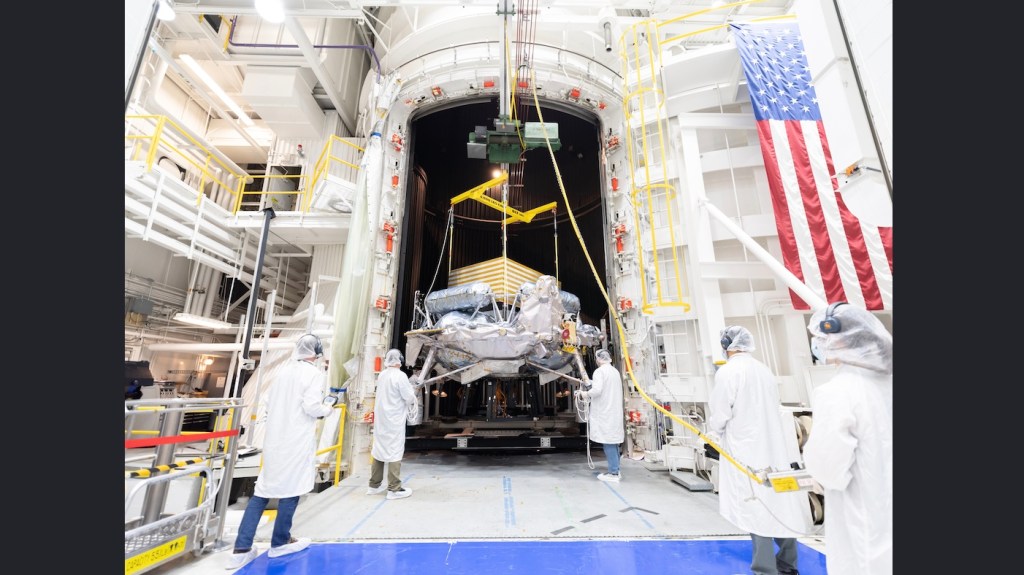
A commercial lander that will be at the forefront of NASA’s efforts to establish a Moon Base, humanity’s first lunar outpost, has passed a series of critical tests at the agency’s Jet Propulsion Laboratory in Southern California. The tests simulated the extreme temperatures and vacuum of space, as well as the intense shaking and ear-splitting roar of launch. Results show that Voyager Technologies’ Griffin Mission One (Griffin-1) spacecraft is ready to survive the rigors of space exploration.
As part of NASA’s CLPS (Commercial Lunar Payload Services) initiative within the Moon Base Program, Griffin-1 is expected to launch later this year aboard a SpaceX Falcon Heavy rocket. It will deliver more than 1,100 pounds (455 kilograms) of cargo to Nobile Crater near the lunar South Pole, which categorizes it as an infrastructure-class lander. Griffin-1 will carry 10 science and technology demonstrations from six countries, including the largest commercial payload ever delivered to the Moon, Astrolab’s FLIP (FLEX Lunar Innovation Platform) rover.
“NASA JPL’s Environmental Test Laboratory has been putting robotic explorers to the test since the Ranger program gave us NASA’s first up-close views of the Moon’s surface in the mid-1960s. We’re proud to provide our expertise and facilities to support this new phase of commercial lunar exploration,” said Charles Whetsel, manager, Exploration Systems Development Office at JPL.
Testing began in July after the 2,789-pound (1,265-kilogram) spacecraft took a cross-country road trip from Voyager Lunar Systems’ manufacturing facilities in Pittsburgh to JPL in the San Gabriel Mountain foothills. Engineers spun the spacecraft on a special table to measure its mass properties, a test that enables them to look for any unexpected wobbles as they assess how the lander will move through space. Data gathered in mass properties testing is key to understanding the spacecraft’s readiness for navigation in flight and landing on the lunar surface.
To make sure signals from the spacecraft’s electronic components don’t interfere with one another, Griffin-1 underwent electromagnetic interference and electromagnetic compatibility testing inside what’s called an anechoic chamber, in which long foam spikes line the walls to absorb sound and electromagnetic waves.
During vibration testing, hundreds of sensors monitored Griffin-1 as a “shaker table” rattled it in three directions, with increasingly intense force, to simulate the ride out of Earth’s atmosphere on a massive rocket. To mimic the roar of launch, giant horns, powered by compressed nitrogen gas, blasted the spacecraft with up to 153 decibels inside a sealed acoustic chamber.
Environmental testing took place in several clean-room facilities at JPL, culminating in the 25-Foot Space Simulator , a thermal vacuum chamber listed on the National Register of Historic Places for its role in supporting historic missions like those of the Ranger , Surveyor , Mariner , and Voyager programs. Dozens of other missions (along with plenty of upgrades to the testing facility) have followed over the decades, including the Perseverance Mars rover and Europa Clipper .
Beneath the thermal vacuum chamber’s soaring 85-foot (26-meter) ceiling, for about two weeks, Griffin-1 alternately baked at up to 167 degrees Fahrenheit (75 degrees Celsius) and froze at temperatures as low as minus 148 F (minus 100 C). This testing simulates the temperature extremes the lander will experience during its journey through the vacuum of space and its operations on the lunar surface.
Cryptographic Security & Key Generator
Generate entropy-tested high-security keys and encryption-grade tokens.
Source: NASA.
Read the full story at the original source ↗
For questions: mrsmithcons@gmail.com.
❓ Frequently Asked Questions (Mars Missions Briefing)
What orbital telemetry or sensor data corroborates this Mars Missions discovery?
Multi-spectral satellite imagery, radar altimetry, and space agency observational feeds provide calibrated observational data confirming the parameters of this event.
How does this observation impact current aerospace and geospatial modeling?
The recorded metrics refine atmospheric correction algorithms and orbital ephemeris models, enabling higher resolution tracking and trajectory accuracy.
When is the next telemetry downlink or public briefing scheduled?
Real-time space agency mission updates and satellite overpass data are ingested continuously through FreeSky Cosmos tracking desks.
🔭 Full 4K Astrophotography Dossier & Scientific Analysis
Raw multi-band infrared composite data, spectral graphs, and mission notes.
⚡ Access Cosmic Dossier ➔More from FreeSky Cosmos
 🛰️ FreeSky Aerial
Die NASA führt einen Überflug durch und bindet NFL-Fans im MetLife Stadium ein
Im Rahmen des Inspiration Tour-Überflugs der Agentur wird NASA-Administrator Jared Isaacman am Sonntag, den 11...
iPhone Duo Pre-Order Survival Guide
Getting the new iPhone on day one is a battle. This guide reveals three essential steps, from using the right ...
 🤖 WinBar AI
Meta is betting the house on AI — CFO warns the stakes are 'really bad' if it flops
Breaking coverage reported by AOL.com: Meta is betting the house on AI — CFO warns the stakes are 'really bad'...
 ☁️ FreeSky Cloud
Ein Agent Development Kit, fünf Sprachen
Wenn wir über Agenten sprechen, bedeutet das nicht unbedingt, dass wir über Python sprechen. Im heutigen moder...